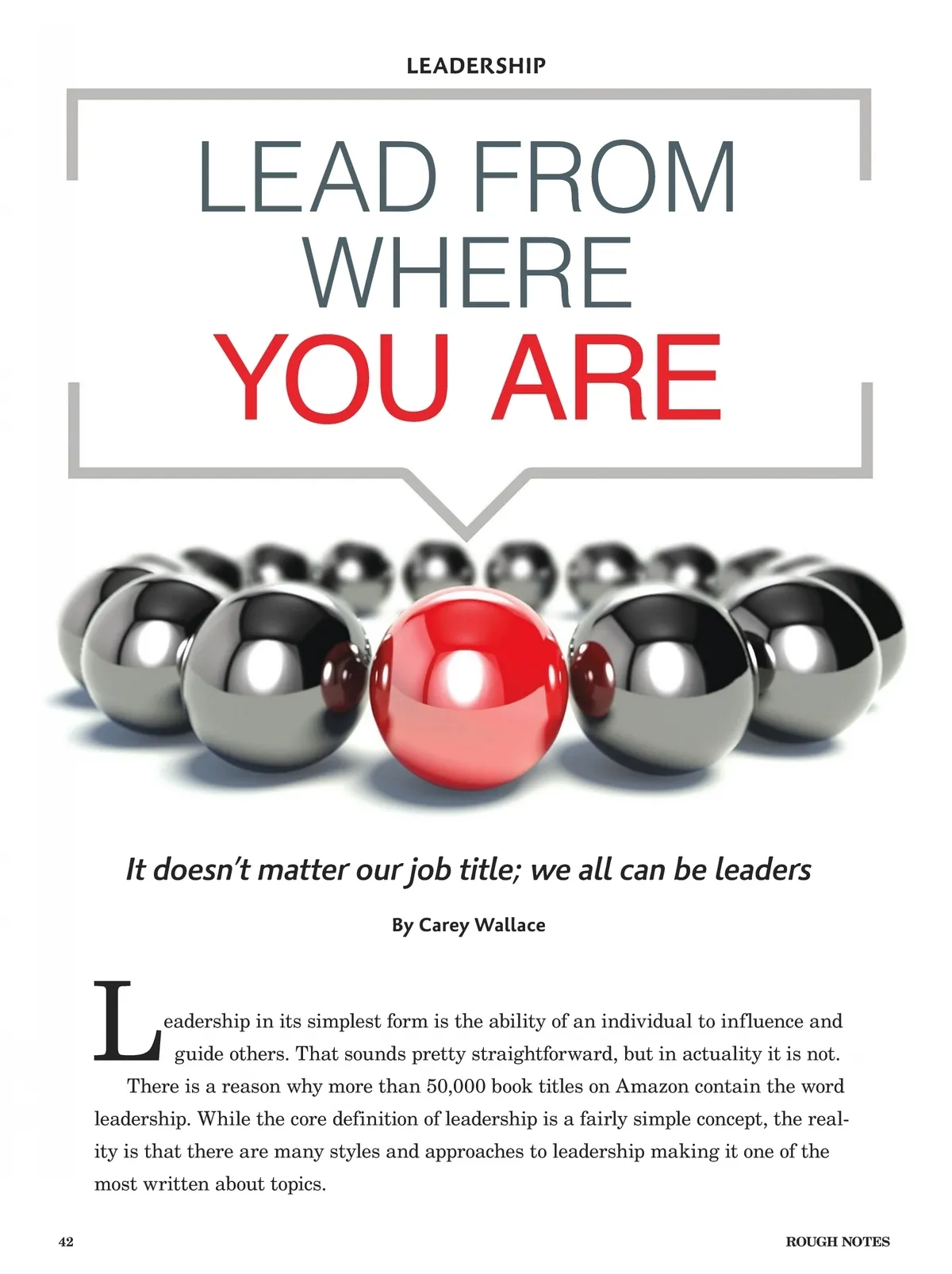
To complicate matters, we all seem to have perceptions of what a good leader is and who can even be a leader. We can all most definitively spot a bad leader, but we may struggle to know what leadership looks like in every role and stage of our journey. The most exciting part about leader-ship is that we all have the same opportunity to lead from any position. More than a title One of the most fascinating things about true leadership is that it has little to do with titles or commanding authority, and everything to do with common core qualities. People do not follow titles, they follow leaders, and the best leaders lead through influ-ence, not authority. The reality is that the world is filled with many great leaders who have absolutely no title; they have core qualities that are far more pow-erful than any title. This means that whether you are a producer, agency owner, account manager, client ser-vice representative, bookkeeper, or receptionist it does not matter; we all can lead. “Leader” is many times an unspo-ken title that is subconsciously given to those who possess the ability to con-nect, empathize, and build trust, with integrity, confidence, and humility. Connectors. One of the best ways to connect with the people around you is to listen. The best leaders have a genuine way of making other people feel like there is nothing more important than the conversation that they are having at that moment. They are active listen-ers who make the people around them feel both heard and understood. Feeling a connection to others is a core component to any effective team, and those who can build and reinforce connections naturally emerge as lead-ers and people others want to follow. Some of the best connectors in an agency are the account managers and CSRs who connect and listen to clients every single day. While it may seem simple, listen-ing can be one of the toughest skills to master in our world today, but it is one of the best ways to connect. Empathy. Nobody likes the feel-ing of being alone and nobody likes to feel like nobody else understands their point of view. An empathetic leader has the abil-ity to think like they were in someone else’s shoes. One of the best ways to demonstrate that you care about another person is the ability to empa-thize with them and their situation. We are in the people and relation-ship business, so empathy is a quality MAY 2024 that is necessary to be successful and lead within every role inside an agency. It is an innate trait that is particularly important to connect and foster a deep level of respect for others; sadly, it is not a quality that can be easily taught. Empathetic leaders are some of the most influential leaders because of their natural ability to form deep connections. Trust. To influence others, you must first build trust. Trust is a foun-dation that is developed over time and through consistency in our actions. It requires integrity, accountability, and vulnerability. For a co-worker, client, partner, or manager to be open to your ideas, place their confidence in you, and see you as someone who understands them enough to follow your lead, they have to trust you first. Great leadership is rare, but it is unmistakable when you experience it. Many times, we are building trust with others when we least expect to. When I first started my career, I thought that others always had it all figured out and that I was the only one who had doubts and felt uncertain. When someone I looked up to on my team confided in me that they made a mistake and asked my opinion, it was a relief; I realized I was not the only one. Their vulner-ability created a bridge that did not exist before and allowed me to feel safe enough to open up more to them. The best leaders are brave enough to be vulnerable. Integrity. We all know the saying that actions speak louder than words. I once heard the late North Carolina insurance legend Bobby Salmon say: “What you do is so loud I can’t hear what you said.” The best leaders are the ones who demonstrate their values through their actions, especially in the toughest times. They are consistent and reinforce repeatedly that you can count on them to do the right thing. One of the best ways to lose cred-ibility is to contradict yourself. With strong leaders, there is never a time when what they say and what they do are inconsistent. The best leaders operate in a way that they hold them-selves accountable. Whether you are responsible for customer service, sales, accounting, or the entire agency, integrity is a non-negotiable quality. Great lead-ers set their standards for personal integrity extremely high. They take responsibility for issues, offer help to others, and expect nothing in return. Those people who “walk their talk” and stay true to their core beliefs make it extremely easy for others to follow. Decisive. A strong leader can make sound decisions that others can support. They will welcome ideas, encourage debate, and possess the ability to see and weigh multiple viewpoints, and then be fair and swift in their decisions. It is critical to set a direction for others; part of doing that is remov-ing the uncertainty in a situation and having the confidence to be decisive. The best leaders will model this skill set and empower others to build strong decision-making skills and create an environment where the people around them feel empowered to make decisions. The biggest reason decisions are not made is the fear of being wrong. Any person in any role within an agency can create that safe space, as we all play a role in shaping the cul-ture of our organizations. Great leaders remove that fear by the way they react and by creating an environment that celebrates failures as much as wins. Beyond the checklist There are lists upon lists of qualities and traits that make a great leader, but when you get down to it, it is all about how you care for and treat others. While leadership seems incredibly simple, achieving it is not something that comes easily to everyone. So many of us mistakenly assume that leaders are only those who have titles, authority, or a particular position. We believe that without those things we can’t lead. The reality is that leadership has very little to do with titles and every-thing to do with a person’s core values, beliefs, and the way they interact with others. We all have the opportunity to lead from any position. 43
Rough Notes May 2024: Page 43